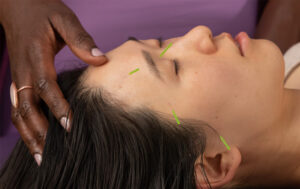

TMJ Acupuncture: Relief for Jaw Pain & Tension

Share

In this Article

Key Takeaways

Topic Summary
Jaw Tension & TMJ Fine needles placed at facial and jaw points to relax muscle tension and support nervous system regulation. 
Facial Acupuncture Basics Uses fine needles on facial points for 20-40 minutes per session. Connects to body’s energy pathways for overall healing effects.
TCM Perspective Jaw tightness is often linked to Liver Qi stagnation — the body’s response to stress and suppressed emotion.
Whole-Body Approach Sessions often combine facial points with body points to address the root stress response, not just the jaw.
Complementary Care Works well alongside dental guards, physical therapy, or other TMJ treatments — not a replacement for dental care.
Recommended Services 
Facial Acupuncture Service Answering Your Top Five Facial Acupuncture Questions Professional facial acupuncture sessions specially designed for MS symptom relief. Expert practitioners provide personalized treatment plans. Book Appointment

Your jaw might be one of the most honest parts of your body. It’s often where we store the things we don’t say — stress we swallow, frustration we grit through, emotions we clench down on without realizing it. If you’re waking up with a sore jaw, dealing with tension headaches, or noticing your face feels tight by the end of the day, you’re not imagining it — and you’re not alone.

Website image

Get expert tips on healthy living and aging gracefully at 40 and beyond from me.

Why Jaw Tension and TMJ Pain Happen

Jaw tension and temporomandibular joint (TMJ) discomfort can show up as:

  • Clenching or grinding, especially at night
  • Soreness or tightness along the jawline or temples
  • Clicking or popping when you chew or open your mouth wide
  • Tension headaches that start at the jaw and spread upward
  • A general feeling of “holding” in the face, even at rest

Stress is one of the biggest drivers here. When your nervous system is in a heightened state, the jaw is often where that tension lands first — sometimes without you noticing until it’s already sore.

How Facial Acupuncture Helps

In Traditional Chinese Medicine, jaw and facial tightness is often connected to Liver Qi stagnation — the body’s pattern for holding onto stress, frustration, or emotion that hasn’t found another way to move through you. Facial acupuncture works with fine needles placed at specific points along the jaw, temples, and face to help release that held tension and encourage Qi to flow more freely again.

Sessions often go beyond the face itself. I’ll frequently combine facial points with body points that support your nervous system more broadly — because jaw tension is rarely just about the jaw. It’s usually a signal that your whole system needs to come out of “on guard” mode.

What to Expect in a Session

A session usually starts with a conversation about where you’re holding tension and what’s been going on for you lately — stress, sleep, habits like clenching or grinding. From there, fine, sterile needles are placed at relevant facial and jaw points, along with body points as needed. Most people find the sensation to be mild — a light pressure or tingling rather than pain.

Many clients notice their jaw feels visibly looser by the end of a session, and some feel a wave of relaxation move through the whole face. It’s common to feel a little more tired or “unwound” afterward, which is a good sign your body is letting go of tension it’s been holding.

Facial Acupuncture Alongside Other TMJ Care

Facial acupuncture works well as a complement to other TMJ treatments — a night guard, physical therapy, or dental work — rather than a replacement for them. If your jaw pain is severe, persistent, or connected to a structural issue, it’s worth looping in your dentist or a TMJ specialist alongside acupuncture care.

FAQ

Frequency Asked Questions

It can help address the stress and tension that often drive clenching and grinding, though it works best alongside habit-awareness strategies and, if needed, a night guard from your dentist.

Many clients notice some jaw softening within the first 1–2 sessions, though a series of weekly sessions over several weeks tends to bring more lasting change, especially if stress is an ongoing trigger.

No — facial needles are very fine, and most people describe the sensation as light pressure or a mild tingle rather than pain.

No. Facial acupuncture is a complementary approach — it works well alongside dental or physical therapy care, not in place of it.

Yes. The jaw is a common place for the body to hold stress and unspoken emotion, and it often tightens as part of the body’s overall stress response.

Share
Pin
Tweet
Related

Perimenopause Insomnia: Causes and Acupuncture Relief

If you’re in perimenopause and tossing and turning every night, you’re not alone. Hormonal shifts can wreak havoc on sleep, but acupuncture might be the relief you need. Here’s how it works and why many women swear by it.

Perimenopause Anger: From Rage to Renewal

Perimenopause anger can feel overwhelming—like a sudden storm of frustration you can’t control. Hormonal shifts play a big role, but there are ways to manage it. Here’s what’s really happening and how to find calm again.

Comments

What do you think?

Leave a Reply

Your email address will not be published. Required fields are marked *

instagram:

This error message is only visible to WordPress admins

Error: No feed with the ID 2 found.

Please go to the Instagram Feed settings page to create a feed.